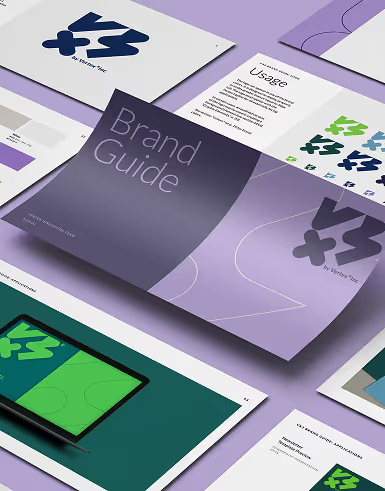
Rebranding stands for the process of creating a different look and feel for a product or company with previously established public appearance. The common purpose of rebranding is to change or enhance a customer's perception of a product, service, or company. It refines the brand and makes it more contemporary, convenient, and related to the customers' necessities.
Rebranding refers to a strategy of presenting a new name, website, logo, or change in design. The intention behind it is to build a modified identity for an already-established brand and differentiate it from its competitors.
For example, imagine you own a popular write my essay service. At some point, you notice that attracting new customers becomes harder and more expensive. Moreover, you’re running out of ideas for retaining your existing customers because your competitors lure them away. This case is a clear sign you need rebranding.
Centralizing the attention solely towards the core business needs often influences the company's image negatively. Meeting one deadline after another wears people out, which affects the entire brand and makes it lifeless and outdated.
The team can be too preoccupied to come up with innovative ideas regarding web or graphic design. Collaboration with Designers is necessary, and their expertise should serve as a guide throughout the entire rebranding process.
Reasons to Rebrand
Several reasons get companies to think about rebranding. One of the most visible and vital factors is to connect with users or customers. Rebranding has numerous advantages, and it often leads to success. But at the same time, it can be risky for a business to alter its recognizable features. Users and consumers might be quick to judge the newly adopted image, and the outcome might not be as expected. Luckily for the business owners, there are rebranding strategies that can help them out and ensure their positive achievements. And, the first step towards successful rebranding is to determine what you think a makeover will change.
Why do you want to rebrand?
So, before you take the first step of a Rebranding Strategy, this is the question you need to answer carefully.
If you’re contemplating changing your logo, website design, or any other visual element, there must be an unquestionably good reason for that. Still, before you jump into the rebranding process, make sure to check out other related aspects. If the brand awareness doesn’t seem optimal, and you’re afraid that the efforts your team invests in this area don’t pay off, there could be other potential causes you should look into. Maybe you could raise brand awareness by developing a new marketing strategy, after researching the market more thoroughly.
However, if the reasons for rebranding come from some internal changes, merging with another company, changing the objectives, or moving to a new location - go for it. These reasons are legit, and the necessity to form a rebranding strategy is undeniable.
If you are expanding your business and conquering a new market, modifying your company’s looks is in order. The rebranding also comes handy when targeting a new customer profile. A brand’s design plays a crucial role in being accepted and recognized within a specific market and its audience. If it seems like you’ve outgrown your image, that’s another natural and understandable reason for recreating it.
Not all reasons for a rebranding are equally obvious, but they all are important, and they all require a delicately crafted plan.
Partial and Total Rebrand
Another crucial step of a rebranding strategy is determining whether your business needs a partial or a total rebrand. A rebranding strategy cannot be implemented without acknowledging the difference between these two types.
Partial rebrand feels less invasive, and it still carries a bit of attachment to the good old public perception of the business. It is usually recommended to the more "mature" organizations. A partial rebrand helps preserve brand loyalty and commitment built with the users or consumers. Refreshing its image enables keeping up with innovations and market needs without making colossal remodelings. A Partial rebrand can be defined as an adjustment focused on visual brand identity.
On the other hand, if your business is experiencing an entire identity transformation, which can include its mission and values, a Total rebrand could represent an ideal solution. The Total rebrand is typically fitting to situations like mergers or other foundational variations.
This option makes everything changeable —a company's name, purpose, market, and entire brand identity.
8 Steps of the Rebranding Strategy
There’s no exact recipe to redesign and rebrand. Each company and its needs are unique, and as such, require distinct approaches. Nonetheless, some steps of the rebranding process should be followed, regardless of the desired outcome and specific necessities.
The main eight steps of the rebranding strategy are:
- 1. Doing the research & defining the audience - reestablishing the brand’s audience and market
- 2. Redefining company’s vision, mission, goals & objectives
- 3. Renaming the company or product
- 4. Reconsider the brand’s slogan
- 5. Rebuilding brand identity
- 6. Choosing a platform & building an online presence
- 7. Staying true to the core values
- 8. Creating a launch strategy
1. Researching the market & reestablishing the audience
Once you’re in the clear regarding your reasons for rebranding, and you’re familiar with the type of makeover you’re craving, it is time to do the research. Any successful strategy implies deep familiarity with the market and its needs and gaps.
After conducting comprehensive market research, which includes target groups and the data gathering and interpretation, you might come to an unexpected conclusion. Your users, customers, clients, or consumers, even your competitors, might seem different from what you used to think they are. Whichever the reason for this new and surprising insight might be, the collected data will back you up and clear things out for you.
Information directs you and helps you outsmart the competition.
2. Redefining company’s mission
Redefining a company’s objectives, purpose, and aims starts with a set of short and concise questions. What? How? Why?
- What is your company doing?
- How are you doing it?
- Why are you doing it?
Once you start to re-evaluate your ideas, mission, and states, that could be a sign that a company is growing. You must redefine your vision as promptly as possible. It ensures all your employees keep their new goals in mind. A redefined vision affects everything from the website design to the hiring process.
Some companies are still heading in the same direction as they did before the rebranding occurred. What has changed is the way they are taking to get there.
With all of these alterations, it is needless to mention that the vocabulary and tone your brand uses has to match the message it’s conveying. The same goes for design and visual identity. Redesigning implies reflecting the company’s values, ways, and preferences while corresponding with modern trends.
3. Renaming as part of rebranding
Renaming isn't a necessary step of a rebranding strategy. Still, some companies find renaming interesting, useful, and worth a while. If you choose to rename your brand, you should make sure to have a recovery plan since this step impacts everything - from the organic search results, to brand recognition.
Renaming might include creating a new word, an acronym, modified spelling of the old name, a slogan that suggests your line of work, translation, or adding a prefix or suffix. And that's just naming a few options.
4. Reconsidering a brand’s slogan
An attractive and unique slogan should be brief, catchy, and should capture a company's mission, goals, and ideas. It sums up the company's purpose and plans. Changing slogans falls a little easier on your marketing efforts than renaming. Nevertheless, you should still think it through.
An effective slogan can be poetic or metaphoric. It should make a claim, and it would be helpful if it were informative. And, last but not least, a good slogan praises the users or customers.
5. Rebuilding brand identity
Creating eye-catching and beautifully designed yet simple elements for your new brand identity is a priority. Rebuilding a brand usually starts with designing a new logo. Some brainstorming about a brand's perspective and goals should come prior to the commencement of the design process. Designing a unique logo with captivating fonts and magnificent colors is an awesome way to put your company or product on the map.
Choosing a proper color pallet has a major influence on the newly redesigned brand. As we all know, certain colors are associated with familiar brands. We all immediately recognize the organization or its product based on the colors they use. Collaborating with Designers who have an in-depth familiarity with color psychology will drive amazing results.
Creating a style guide is particularly important in this stage of rebranding. Internal team members or a third-party designing agency needs to have access to logo variations and usage guidelines, hex codes, fonts, etc. Everyone who is in charge of rebuilding a brand identity needs to remain well-informed throughout the entire process.
Staying simplistic and still making an impact is the aim of each aspiring Designer. Adaptability is another important quality of a successful business. Keeping track of the current trends, tendencies, and demands is inescapable.
6. Building an online presence
Messaging platforms are necessary for consistent explaining of a brand and approaching the users and building an online presence. A messaging platform can include the company’s website, all free content, email and social media marketing, internal communication, and other alternative ways of reaching out. The visual esthetics of a website, app, or social media page must be compatible with each other and with all other aspects of a new brand’s design.
Managing the Online Reputation is a permanent process and the much-needed component of preserving a brand’s value and credibility.
7. Core values
As you rebrand, you need to stay true to your essence. Sure, it is up to you to choose whether your business needs to undergo a full makeover, or just to brush up a little bit. Whether your choice is to redesign your logo or website or to expand your niche and change your aims, there's a certain pulse each business has. The company, the services it offers, or the product it is developing should evolve. Your brand needs to remain up to date from the inside and the outside. But some core values must remain the same, even if the market, the audience, and the product change. The users will recognize, understand, and appreciate it.
8. Launch strategy
Be loud and proud of your launch! You have managed to implement all of the steps of a rebranding strategy successfully. Not to quote every gangster rapper on YouTube and TikTok, but - Go hard or go home, as a figure of speech. You ought to be ensuring that wherever a planned user or customer encounters your brand, they meet its new looks, features, advantages, and offerings.
Show off your gorgeous new design, your brandnew logo, your captivating slogan, your redesigned site, and your matchless efforts to suit your users’ needs.

Tatjana Zotović based recruiter with a knack for writing, Tatjana has been honing her word-smithing skills by putting years of Tech industry knowledge and research to paper. The result is the clear, informed, and most importantly, captivating content that keeps her reader base growing. Find her on LinkedIn.